
Boiler Systems Serviced With Full Inspection First
Boiler Heating Systems in Coopersville for homes and commercial buildings with hot water heat requiring installation or service
Older homes in Holland, Zeeland, and Muskegon that were built with cast iron radiators and hot water heat often have original distribution systems that have outlasted two or three boilers already, but the circulators, expansion tanks, and zone valves that connect those radiators to the heat source are frequently the same age as the last boiler replacement. Ridge Heating & Cooling installs and services boiler heating systems for homes and commercial buildings in Coopersville and across West Michigan, beginning every project with a combustion and safety check that establishes what the existing system is actually doing before any new equipment is proposed. That evaluation catches conditions like a waterlogged expansion tank or a circulator running on worn bearings that would remain after a boiler swap if not identified in advance.
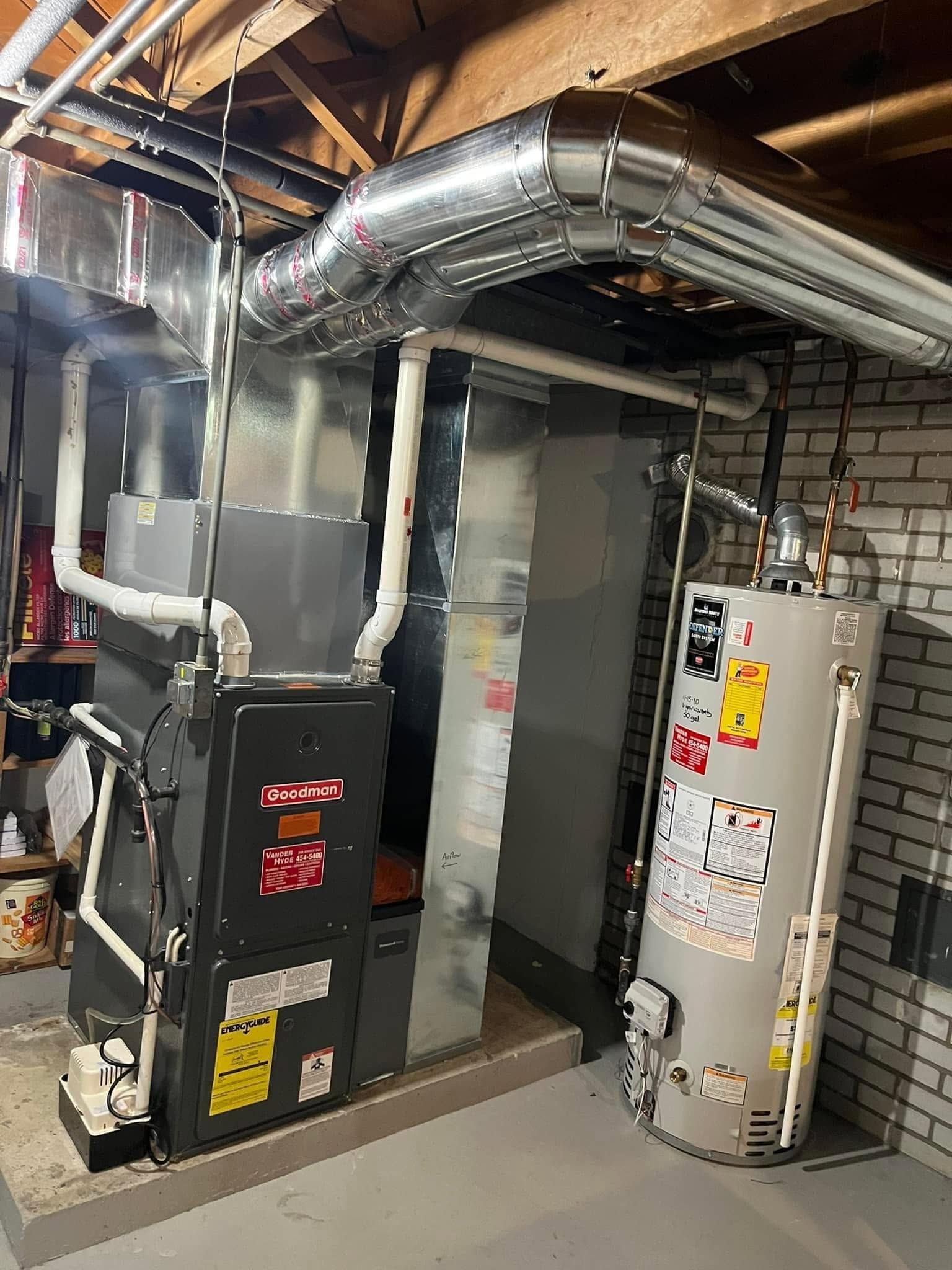
Installation involves sizing the boiler to the building's heat load, verifying the circulators and zone valves can handle the new equipment's output, checking the expansion tank for proper air charge, and confirming the venting path is appropriate for the boiler type being installed. High-efficiency condensing boilers require sealed-combustion venting through PVC rather than conventional flue connections, which affects both the mechanical work and the permitting scope. After the system is filled, balanced, and commissioned, the crew walks through the controls and basic maintenance with the homeowner before leaving the site.
Set up a combustion and system review to assess your current boiler's condition and identify which components warrant attention before or alongside a replacement.
The Difference Between Boiler Replacement and System Replacement
A boiler replacement that ignores the distribution system is a common source of callbacks: the new boiler fires correctly, but an undersized circulator cannot move enough flow through the radiator circuit to satisfy the thermostat, or a failing zone valve leaves one section of the building cold while another overheats. Ridge Heating & Cooling evaluates circulators for flow rate and bearing condition, checks zone valves for full travel, and inspects the expansion tank to determine whether it holds an air charge or has filled with water—the latter causes pressure spikes that trip the relief valve repeatedly and are often misread as a boiler fault.
After a correctly commissioned boiler installation, each zone heats evenly on a thermostat call, the system pressure holds steady within the normal operating band, and the relief valve remains dry. Properties in Byron Center with older two-pipe steam-to-hot-water conversions sometimes require pipe sizing and valve work that a boiler-only replacement would leave unaddressed, making the upfront distribution inspection a cost-saving step rather than an added one.
As an elite HEIL dealer, Ridge Heating & Cooling installs HEIL boiler equipment backed by the manufacturer's warranty, and every installation carries a one-year workmanship warranty from the company. The business is licensed, insured, and a Better Business Bureau member, and accepts all major payment forms so the financial side of the project is straightforward from the start.
Common Questions About Boiler System Work
These questions address the inspection, installation, and commissioning process for boiler systems, covering what gets evaluated and why each step affects the system's long-term operation.
What does a combustion and safety check involve before a boiler is replaced?
The technician measures flue gas composition for carbon monoxide and excess air, checks the heat exchanger for cracks or deterioration, tests the pressure relief valve, verifies the low-water cutoff function, and inspects the venting for obstructions or improper connections—each item affects safe operation independently of the boiler's firing efficiency.
How is a replacement boiler sized when the original unit's rating plate is no longer readable?
The technician calculates the building's heat load from the radiation installed—measuring each baseboard or radiator section and applying an output factor for the element type—which gives a more accurate load figure than a nameplate rating that may have been oversized when originally installed.
Why does an expansion tank that has filled with water cause pressure relief valve trips?
A properly charged expansion tank absorbs the volume increase as system water heats up; when the air charge is gone, that volume has nowhere to go and drives system pressure above the relief valve's set point, causing it to open on every heating cycle even though the boiler itself is operating correctly.
What should be inspected in the distribution piping of an older home in Coopersville before a boiler is installed?
Cast iron and older copper distribution systems should be checked for sludge accumulation that restricts circulator flow, for isolating valves that have seized open or closed, and for radiator air vents that no longer open to release trapped air—conditions that a system flush and vent replacement can address before the new boiler is commissioned.
How does the venting requirement differ between a standard and a high-efficiency condensing boiler?
A standard boiler exhausts high-temperature gases that rise reliably through a conventional Type B or masonry flue; a condensing boiler operates at lower exhaust temperatures and must vent through sealed PVC piping with a separate combustion air intake, which is a material and permitting difference that affects the installation scope and wall penetration locations.
Ridge Heating & Cooling also installs and services boiler systems in Grand Rapids, Hudsonville, Holland, Allendale, and Rockford. To arrange a system evaluation or discuss a boiler replacement for your home or building, call (616) 520-8505 and describe the existing equipment, the number of zones, and any symptoms the system has shown recently.