
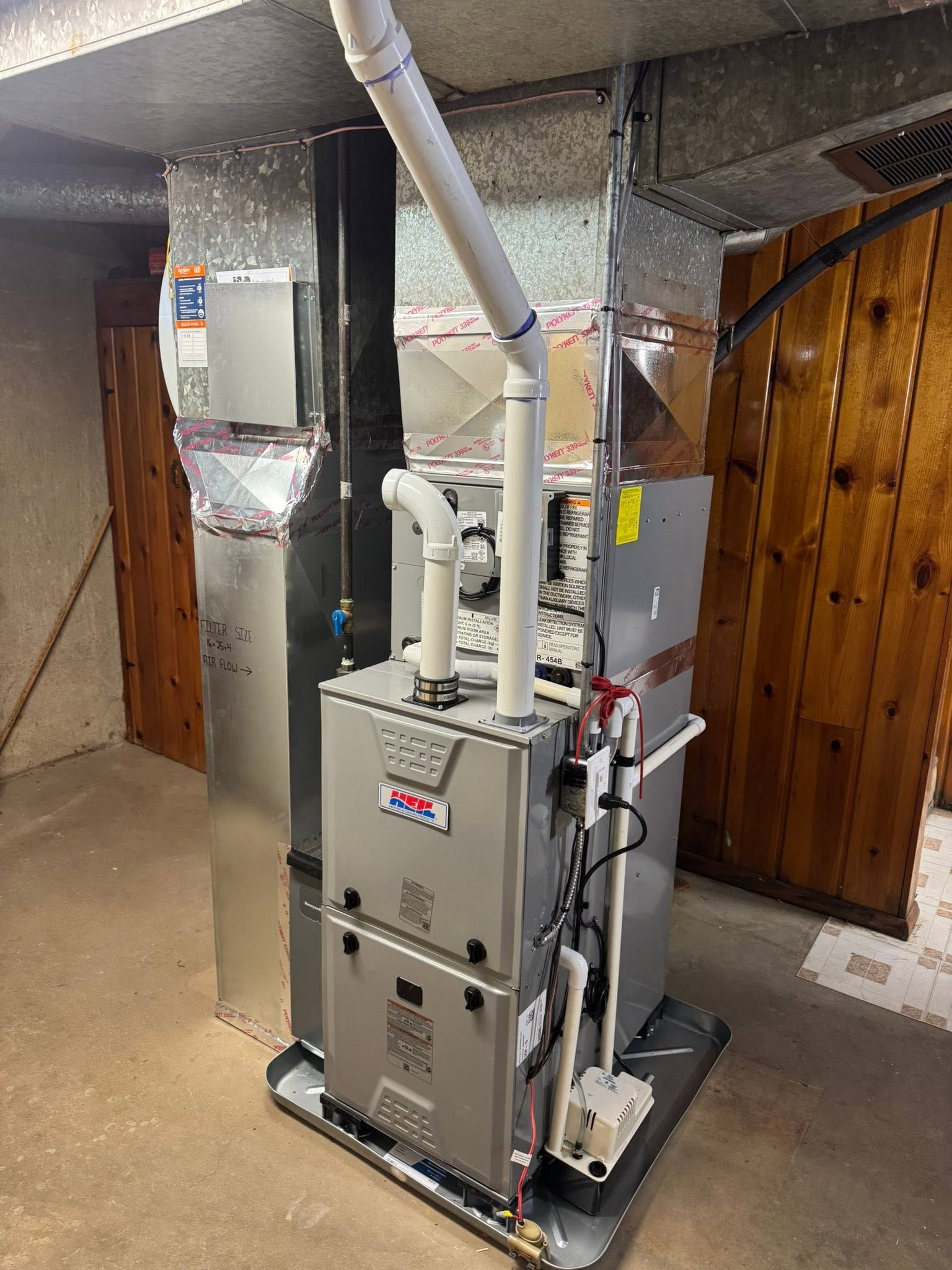
New Furnace Sized Right From the Start
Furnace Installation in Coopersville for homes replacing aging equipment or updating undersized systems
Many homes across Kent, Ottawa, and Muskegon counties were built as farmhouses or rural properties on the outer edge of the metro, and their ductwork, venting, and gas connections were sized for equipment that no longer exists. Ridge Heating & Cooling installs furnaces for homes and buildings across Coopersville and West Michigan, beginning every project by calculating the home's actual heat loss rather than matching the output rating of whatever unit came out. That distinction matters because a furnace sized too large short-cycles, wears its controls prematurely, and fails to dehumidify the air moving through the ducts.
As an elite HEIL dealer, Ridge Heating & Cooling installs HEIL equipment backed by the manufacturer's warranty and pairs that with a one-year workmanship warranty on the installation itself. The process starts with sizing, then moves to a duct and venting inspection before the old unit is removed, because ductwork that worked adequately with the previous furnace may be undersized for a higher-efficiency unit that moves air differently. Once the new furnace is set and connected, the crew tests ignition, gas pressure, safety controls, and airflow before the job is considered complete.
Request an installation estimate that includes a heat loss calculation and a review of your existing ductwork and venting conditions.
How Proper Furnace Installation Is Done Correctly
Sizing the furnace to the structure is the step that separates a competent installation from one that will cause problems within the first few heating seasons. Heat loss calculations account for ceiling height, insulation values, window area, infiltration rate, and the home's footprint—not just square footage. Older farmhouses and rural properties in the Coopersville area frequently have high infiltration rates and uninsulated crawl spaces that shift the load significantly compared to a similarly sized suburban new build.
After installation, the home heats evenly through each room on the thermostat's call, the unit reaches temperature without short-cycling, and combustion gases vent fully to the exterior without back-drafting through the flue. Ridge Heating & Cooling's technicians verify these outcomes during commissioning rather than leaving them to the homeowner to discover later. Comstock Park properties with older metal duct systems sometimes require damper adjustments after a new furnace is connected, because the airflow characteristics of modern variable-speed blowers differ from the single-speed motors they replace.
The Fair State HVACR program credentials held by Ridge Heating & Cooling reflect formal training in load calculation and system design, not only mechanical installation. That background informs decisions like whether existing venting needs to be relisted from Type B to PVC when a high-efficiency condensing furnace is installed, which is a code requirement that affects the long-term safe operation of the system rather than just a detail of the installation day.
Questions Before Starting Your Furnace Project
These questions address how furnace installation decisions are made and what the process involves from first visit through commissioning.
What happens during the heat loss calculation before a furnace is sized?
A technician measures the conditioned floor area, assesses ceiling height, window area, insulation levels, and infiltration, then applies those values against local design temperatures to determine the BTU output the home actually requires.
Why does the existing ductwork need to be checked before the new unit is chosen?
A high-efficiency furnace with a variable-speed blower moves air at different static pressure than older equipment, and ducts that are too small or have too many sharp transitions will reduce airflow and trigger the unit's limit switches prematurely.
How does venting change when a high-efficiency condensing furnace replaces a standard unit?
Condensing furnaces produce lower-temperature flue gases that cannot reliably rise through a conventional metal chimney, so the venting typically changes to PVC pipe exiting through a sidewall, which is a code-mandated modification and not an optional upgrade.
What safety checks are completed before the installation is called finished?
The technician verifies gas pressure at the manifold, confirms the heat exchanger shows no visible cracks, tests each safety limit switch for proper operation, and measures carbon monoxide levels at the supply registers before leaving the site.
How does the age and construction of a home in Coopersville affect which furnace model is appropriate?
Older farmhouses with high ceilings, minimal attic insulation, and large single-pane windows carry a significantly higher heat load per square foot than post-2000 construction, which pushes the required output upward and may also require a variable-speed unit to manage humidity levels the old equipment never addressed.
Ridge Heating & Cooling also installs furnaces in Hudsonville, Grand Rapids, Holland, Allendale, and Rockford. To begin with a heat loss review and a look at your existing system, call (616) 520-8505 and describe the home's age, size, and any airflow concerns you have noticed.